You know your service is better. Your technicians are more experienced. Your response times are faster. Your quality is higher. You can prove it with certifications, testimonials from happy customers, and years of flawless work.
But prospects still choose your competitor. The one who showed up late last week. The one whose Google reviews mention "okay service" and "got the job done." The one you know cuts corners.
Here's the painful truth most business owners refuse to accept: your service quality doesn't matter if prospects don't trust you before the first conversation. You're losing deals not because your service is inferior you're losing because you haven't systematically built the trust signals that make prospects believe you're the safe choice.
This guide reveals why trust not service quality determines who wins customers in competitive local markets. You'll learn the exact trust gaps killing your conversion rate, the systematic trust-building framework that converts skeptics into buyers, and the automated reputation systems that generate trust signals at scale while you focus on delivering excellent service.
TL-DR Most business owners believe better service wins customers. It doesn’t. Trust wins customers, and service quality only matters after trust is established. The “trust gap” costs local businesses 40–60% of potential conversions because prospects can’t evaluate quality before buying. Businesses that systematically build trust through high-volume review generation, strategic social proof placement, and transparent communication convert 2–3x more leads at 15–25% higher prices than competitors offering equal or even better service. The real solution isn’t improving your service—it’s building automated trust generation systems through reputation management platforms that create belief before prospects ever make contact.
"Trust converts first. Service proves it later."
The Trust Problem You're Not Seeing
Let's diagnose the real reason you're losing deals:
Monthly Inbound Leads: 45 Your Close Rate: 18% (8 customers) Competitor's Close Rate: 42% (19 customers with same lead volume)
At $850 average job value:
Your monthly revenue: $6,800
Their monthly revenue: $16,150
Annual difference: $112,200
Your service quality is irrelevant if prospects never trust you enough to become customers.
Why Service Quality Alone Doesn't Win Customers
Here's what business owners get wrong:
Myth 1: "Good Service Speaks for Itself"
No, it doesn't. Good service creates satisfied customers. But satisfied customers don't automatically generate trust signals that reach future prospects.
The Invisible Excellence Problem:
Your excellent service is invisible until prospects become customers. But they need to trust you BEFORE becoming customers to experience your excellence.
You're trapped in a catch-22:
Can't prove quality without customers trying you
Can't get customers without proving quality first
Myth 2: "Word of Mouth Will Grow My Business"
Word of mouth is slow, unscalable, and geographically limited. It works for lifestyle businesses. It fails for growth-focused businesses in competitive markets.
Word of Mouth Reality Check:
Average referral rate: 3-8% of customers (even when happy)
Time delay: 3-12 months between service and referral action
No targeting: Referrals come when they come, not when you need them
Meanwhile, your online reputation works 24/7, reaches your entire service area, and compounds over time.
Myth 3: "Price Is Why I'm Losing Deals"
When prospects lack trust, they default to price comparison. But when trust is established, price sensitivity drops dramatically.
The Trust-Price Relationship:
Low Trust Scenario:
Prospect gets 4-5 quotes
Focuses on price differences
Questions why you charge more
Likely chooses cheapest option
High Trust Scenario:
Prospect calls you first
Gets 1-2 quotes (if any)
Assumes higher price = higher quality
Chooses you despite not being cheapest
Your pricing isn't the problem. Your trust signals are.
Myth 4: "I Just Need More Advertising"
More ads without trust signals = more wasted ad spend.
What Actually Happens:
You increase ad spend from $2,000 to $4,000/month. Your leads double from 40 to 80/month. Your close rate stays at 18%. You convert 14 customers instead of 7.
Cost per customer: $285
Competitor with strong trust signals:
Same $2,000 ad spend
Same 40 leads/month
Close rate: 42%
Converts 17 customers
Cost per customer: $117
They're not spending more on ads. They're converting better because trust is pre-established.
The Trust Architecture: Five Layers That Convert Skeptics
Here's how to systematically build trust that converts:
Layer 1: Volume-Based Social Proof (The Foundation)
The Trust Threshold:
The easiest way to do this is by using an automated system that consistently helps you get more reviews from satisfied customers without relying on manual follow-ups.
Research shows clear trust benchmarks based on review volume:
0-10 reviews: High skepticism, minimal trust
11-25 reviews: Initial credibility, still price-sensitive
26-50 reviews: Moderate trust, willing to consider
51-100 reviews: Strong trust, less price-sensitive
100+ reviews: Maximum trust, commands premium pricing
The volume itself signals:
Legitimacy (not a fly-by-night operation)
Popularity (many people have used successfully)
Consistency (quality maintained over time)
Your Volume Target:
Calculate the trust threshold for your market:
Identify top 3 competitors in local pack
Record their review counts
Set target: 120-150% of average competitor
Example:
Competitor A: 127 reviews
Competitor B: 189 reviews
Competitor C: 156 reviews
Average: 157 reviews
Your target: 190-235 reviews (120-150% of average)
Layer 2: Recency-Based Relevance (The Currency Signal)
The Recency Trust Factor:
Instead of hoping customers remember to leave feedback, you can proactively get more reviewsthrough structured follow-ups that run automatically after every completed job.
Reviews aren't just social proof they're currency that loses value over time.
Prospect Psychology:
Reviews from last week: "They're active and currently serving customers like me"
Reviews from 3 months ago: "Are they still in business? Is quality still good?"
Reviews from 6+ months ago: "This might be outdated information"
The Recency Formula:
Never let more than 7-10 days pass without a new review. This signals:
Active business operation
Current customer satisfaction
Ongoing quality maintenance
Implementation:
Using an automated review request system, maintain consistent review velocity that prevents gaps:
Target: 3-5% of monthly customers leave reviews
Minimum velocity: Never exceed 10-day gap between reviews
Optimal velocity: 2-4 reviews per week
Layer 3: Response-Based Engagement (The Care Signal)
What Review Responses Actually Communicate:
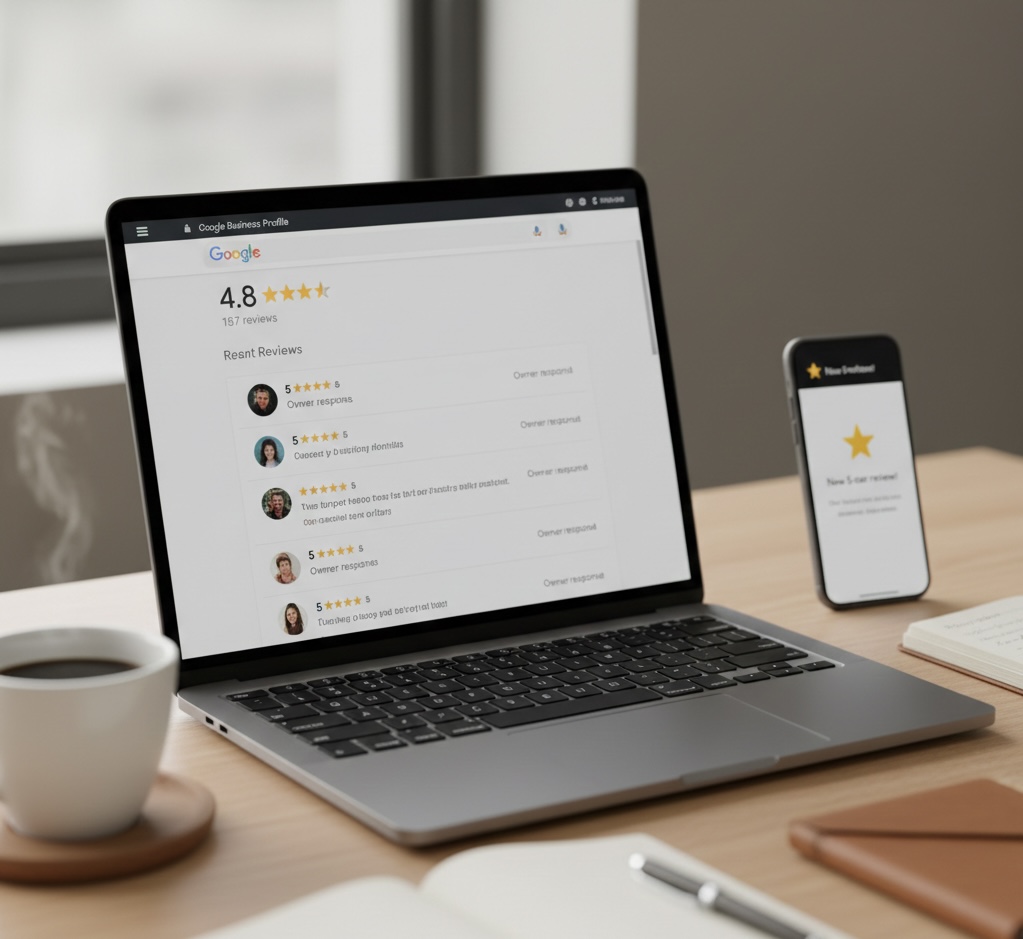
Businesses that actively respond to reviewsshow prospects that they care about feedback, accountability, and long-term customer relationships.
When prospects see you respond to reviews, they're not reading the words they're reading the subtext:
100% response rate signals:
"This business actively monitors feedback"
"The owner/manager personally cares"
"Problems get addressed, not ignored"
"This is a real business with engaged leadership"
Selective or no response signals:
"They might ignore my issues too"
"Is anyone actually managing this business?"
"Maybe they only care about getting paid, not customer experience"
The Response Impact Study:
Businesses with 90-100% response rates convert at 35-45% higher rates than businesses with <50% response rates even with identical service quality and review ratings. A centralized reputation dashboard allows you to monitor every review, track response rates, and measure trust growth in one place.
The Strategic Response Framework:
For Positive Reviews:
Respond within 24 hours
Personalize (mention specific detail)
Thank genuinely
Reinforce what they appreciated
Invite return/referral
For Negative Reviews:
Respond within 12 hours
Acknowledge specific issue
Take responsibility
Explain corrective action
Offer private resolution
(See comprehensive negative review management strategies in related guides)
Layer 4: Content-Based Credibility (The Specificity Signal)
Generic Reviews Build Minimal Trust:
"Great service!" (7 word review) "Highly recommend!" (2 word review) "Very professional" (2 word review)
These provide weak trust signals because they lack specificity.
Detailed Reviews Build Maximum Trust:
"Called at 9pm with a burst pipe flooding our basement. John arrived within 45 minutes, had the right parts in his truck, and had us fixed up by 11pm. Explained everything clearly and charged exactly what he quoted over the phone. Saved us thousands in water damage." (48 words)
"If you have a moment, we'd love if you could share what specific part of your experience stood out— whether it was [technician name]'s expertise, how we handled your timeline, or the quality of the final result. Details like that really help other [homeowners/businesses] understand what to expect."
However, when reviews are false, malicious, or violate platform policies, you may need to properly remove bad reviewsbefore they damage your long-term credibility.
A well-handled 2-3 star review can build MORE trust than ten 5-star reviews because it proves:
Reviews are authentic (not filtered)
Business handles problems professionally
Issues get resolved, not ignored
The business cares about customer experience
Example Trust-Building Negative Review Response:
Review: "Technician was 45 minutes late and didn't call ahead. Work was fine but the delay was frustrating."
Response: "You're absolutely right, and I apologize. We had an emergency call run long that morning and should have contacted you immediately to reschedule or give you an accurate arrival window. We've since implemented a new scheduling buffer system and automated text updates so customers receive real-time arrival notifications. I'd like to make this right please call me directly at [phone]. Thank you for the feedback that helps us improve."
What Prospects See:
Accountability (no excuses)
Action (system improvement)
Care (personal follow-up offer)
This builds more trust than ten generic "Great service!" reviews.
The Five Layers of Business Trust That Drive Conversions
The Trust Generation System
Here's the tactical playbook:
Step 1: Calculate Your Trust Gap
Current State Audit:
Total reviews across all platforms
Days since last review
Review velocity (reviews per 30 days)
Response rate (% of reviews responded to)
Average review length
Rating distribution (% of 5-star, 4-star, 3-star, etc.)
Competitive Benchmark:
Top 3 local competitors' review counts
Their review velocity
Their response rates
Their average ratings
Gap Analysis:
Your Trust Gap = (Competitor Average) - (Your Current State)
"Our 15-year-old furnace was short-cycling and the house couldn't get above 65°. Three other companies said we needed a full replacement ($8,000-12,000). Mike from [Business] diagnosed a faulty flame sensor in 20 minutes, replaced it for $180, and explained exactly why the other companies missed it. Furnace is running perfectly. Saved us $10,000+."
What This Communicates:
Technical expertise (diagnosed correctly when others didn't)
Honesty (didn't upsell unnecessary replacement)
Value (saved customer thousands)
Problem-solving ability (fixed quickly)
One review like this builds more trust than twenty "Great service!" reviews.
Common Trust-Building Mistakes
Mistake 1: Waiting Until Service Is "Perfect"
You don't need perfect service. You need good service + great issue resolution + systematic trust signal generation.
A 4.7-4.8 rating with 150 reviews beats a 5.0 rating with 12 reviews every time.
Mistake 2: Focusing on Review Platforms Instead of Google
Google drives 70-80% of local search traffic. Master Google Business Profile first (100+ reviews, 4.7+ rating) before diversifying to Facebook, Yelp, industry sites.
Mistake 3: Generic Review Requests
"Please leave us a review" = 3-5% response rate Personalized, specific requests = 15-25% response rate
The difference is worth 3-5x more reviews with same effort.
Mistake 4: Ignoring Negative Reviews
Unresponded negative reviews damage trust 3x more than the review itself.
Well-handled negative reviews can BUILD trust by proving you care and fix problems.
Mistake 5: Manual-Only Systems
You cannot manually:
Request reviews from 100% of customers consistently
Respond within 24 hours across all platforms
Route unhappy customers before they go public
Track performance accurately
Manual systems collapse under growth. Automation scales infinitely.
Mistake 6: Hiding Reviews
Collecting reviews but not showcasing them prominently on website, proposals, and marketing materials wastes their trust-building potential.
Your reviews should be impossible to miss.
Real-World Case Study: Trust Beats Service Quality
Business: Local electrical contractor Market: Competitive suburban area (12+ electrical contractors) Challenge: Lower close rate despite superior service quality
Starting Position:
22 years in business
Master electrician with advanced certifications
98% customer satisfaction (tracked internally)
Response time: Under 4 hours for emergencies
Google Reviews: 41, rating 4.5, last review 35 days ago
Close rate: 19%
Top Competitor Analysis:
9 years in business
Standard licensing
Unknown satisfaction rate
Response time: Next-day for emergencies
Google Reviews: 178, rating 4.7, last review 3 days ago
Estimated close rate: 40-45%
The Problem:
Service quality wasn't the issue trust signals were dramatically weaker.
System Implementation:
Month 1-2:
Deployed automated review request system using reputation management software
Average job value: $890 → $1,180 (pricing power from trust)
Monthly revenue: $24,300 → $61,400
Customer acquisition cost: $340 → $165
Annual Revenue Impact: +$444,000
The service quality didn't change. The trust signals did.
Build Trust That Converts
Most business owners obsess over service quality while losing deals to inferior competitors with better trust signals.
The difference isn't luck or marketing budget it's having automated reputation management systems that generate trust at scale while you focus on delivering excellent service.
Review Crusher AI helps local businesses build exactly this system.
Our platform automates review requests at optimal timing to maintain consistent trust signal generation, routes unhappy customers to private feedback channels before they damage public trust, ensures 100% response rate across all platforms through centralized monitoring, and provides the analytics that prove ROI.
Stop losing to inferior competitors. Start building trust that converts.
Ready to build trust that drives revenue? Get started for free and see how automated reputation management converts your service quality into visible trust signals that win customers. Our clients improve conversion rates by 30-50% within 90 days not by improving service, but by systematically building trust.
Your service is excellent. Make sure prospects trust you enough to find out.
Trust Trumps Service Quality
The best service in your market doesn’t win customers—the most trusted service does. Trust is built through systematic signals: 100+ reviews as a competitive baseline, consistent recency with no long gaps, 100% response rates within 24 hours, detailed reviews that address buyer objections, and strategic social proof across every touchpoint. Businesses that engineer trust through automated review generation systems convert 2–3x more leads at 15–25% higher prices than competitors with equal or better service quality. Stop perfecting your service and start systematizing trust.
If my service is great, won't reviews naturally happen?
No. Only 5-10% of satisfied customers leave reviews without prompting. You need systematic request automation to convert your service quality into visible trust signals at scale.
How many reviews do I need before trust impacts conversion?
Meaningful conversion improvements begin at 25-50 reviews. Competitive advantage emerges at 75-100 reviews. Maximum trust and pricing power at 100+ reviews with 4.7+ rating.
What if competitors have huge review leads?
Focus on review velocity, not total count. Consistent 12-15 reviews/month with 100% response rate can create trust parity with competitors who have 2-3x more total reviews but inconsistent engagement
Should I respond to every review, even short positive ones?
Yes. 100% response rate signals active engagement. Even brief "Thank you!" responses contribute to overall trust perception. Prospects notice response patterns more than individual responses.
How long does it take to build trust that improves conversion?
Initial conversion improvements appear within 30-60 days as review count crosses 40-50. Significant competitive advantage develops within 90-180 days with consistent velocity and engagement.
Protect Your Reputation
Stop juggling reviews across different platforms. Centralize everything with ReviewCrusher’s review management software and start getting more reviews in less time.